
Nature Does Not Hurry, Yet Everything Is Accomplished.
or, why a little chaos is good and too much efficiency is bad.

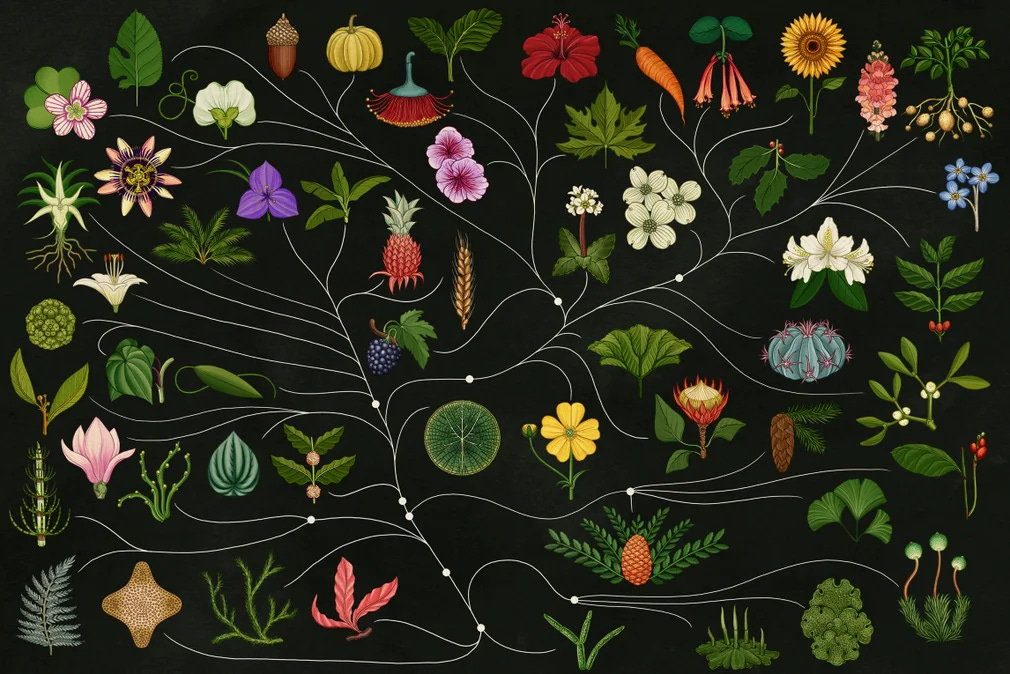
Nature does not hurry, yet everything is accomplished. - Lao Tzu
The reason nature accomplishes so much without hurrying is that it is accomplishing in an incredibly decentralised way. Think of every blade of grass across an entire continent growing a few millimeters taller on a Summer’s day; the net result is a huge increase in Earth’s biomass, but it’s not even noticeable at a local level. What is noticeable is lightning killing a mighty eucalyptus, a grass fire burning a paddock, a plague of locusts denuding a landscape. Destruction is generally far swifter and more sensational than accomplishment.
And this might be why it always seems like the world is collapsing, yet it never quite collapses. Often the quiet work of good is, like nature, so decentralised as to be invisible, unless you’re really looking for it.1 And, to really look for it is a habit of mind that can be nurtured. How does one nurture this habit? A good starting point is to ignore, as much as possible, the sensational, attention-grabbing bad stuff. I’m not saying run away from it; it will trickle in here and there, through conversations with friends and whatnot; nothing wrong with that. In fact, this is how news used to be conveyed for most of human history - person to person; our brains can handle it best this way; disseminated through the network of individual relationships. But drinking from an algorithmically-curated firehose of horror? We can’t cope with that for long.
But back to nature not hurrying. Something I savour deeply is to walk far away from all human activity and sit in silence in some place of natural beauty (ideally next to water)2. After a few minutes, my surroundings begin to ignore me, and everything starts ‘doing its thing’ as if I’m not there; an ant crawls over my leg, a moth lands on my head, everything seems ordered and harmonious, and yet there is no central ‘government’ organising it. Sure, there are local hierarchies (anthills have a queen, wolf packs have a leader, hens have a pecking order) but those are very distributed; there’s no overarching governance for the whole thing, and yet much is being accomplished everywhere I look. Yet nature is not hurrying; she is not the overbearing, managerial type. It’s basically an anarchist utopia.
Some would say that this is a very romantic view of things; that actually it’s tooth and nail competition, brutality and suffering all the way down: viruses killing organisms, wolves mauling deer, parasitiod wasps laying eggs into caterpillars so the caterpillar dies an agonising death while feeding the wasp larvae. Yes, I understand all of that. But if the destruction outweighed the cooperation, the result would be nothingness, rather than beauty and complexity.3
Due to Australia’s ancient history, our leached soils and scarce nutrients have stimulated a whole raft of unique collaborative arrangements to better share such scarce resources. This includes arrangements between birds and plants; bacteria and mycorrhizal fungi and plants; insects, bacteria and fungi; placental mammals, marsupials, microbes and fungi; honey possums or honeyeaters and flowering plants; cooperatively breeding birds, and so on. That is, Australia can boast - via cooperation, symbioses and mutualisms - an extraordinary and long- coevolved variety of organisms working together for mutual survival. This Gondwanan ark truly was and is like no other place on Earth.4
Look around, Gentle Reader; nature has accomplished an awful lot (despite the destruction inherent to it). And maybe the destruction, too, is a necessary part of the creation. Perhaps creativity only happens in an environment of chaos. From what I’ve observed, this seems to be true. An awful lot of beautiful art was created during times of war and upheaval; same with architecture, music, institutions and ideas. Think of the cathedrals that were erected during the Dark Ages. Or of the destruction that meteor impacts, volcanoes, and ice ages have visited upon the earth, only to have nature respond with intense entrepreneurial spurts, changing rapidly in response to the new conditions; tyrannosaurs shrinking, growing feathers, and becoming domestic chickens, for example; or mammals becoming ascendant (guinea pigs the size of rhinocerouses)5 before later downsizing again; or plants coevolving (along with insects) to develop beautiful, fragrant flowers. Nature is both chaotic and orderly. The chaos spawns new kinds of order, and the order spawns new types of chaos.6 7
Another way to think about this is that nature is the opposite of efficient; instead of focusing its energies on ‘the most likely model’ (as a corporate R&D department might do), it develops a near-infinite number of prototypes simultaneously.8 Each organism approaches life in a different way. Is a large, flightless bird a more effective lifeform than a millipede, or a mushroom?9 This is a useless question, because all three exist concurrently, along with countless other lifeforms, all interacting in unbelievably complex ways, inadvertently creating a whole. In times of upheaval, some species will die out, while others will adapt/evolve and still others will already be well-suited to the new conditions. The ginkgo tree, for example, has survived three mass extinction events (including the one that killed the dinosaurs)10. Clearly, the ginkgo is a robust design, one could call it a ‘winning’ design. If the world as we know it ends, the ginkgo will remain. And yet, for whatever reason, ginkgos have not monopolised the biosphere; they remain just one model of many. The overall system we call ‘Life’ is robust, although its component parts come and go.11
In economics, the free market ideal is something like a clumsy version of nature; a creative chaos out of which order can emerge; a system where there is enough freedom for all ideas to be tried concurrently. Command economies are too orderly/efficient and so are not resilient enough to change. They often look tidier (because they often are), and they can work well for a while, but never long-term. They aren’t diverse enough to adapt to cataclysm. The ‘dumb ideas’ aren’t permitted (by those in charge) to happen, and those might be the very ideas that turn out not to be so dumb after all, and end up saving the whole system - or, then again, they might just be dumb ideas - you can’t know beforehand. To be robust, a thing needs to be a bit messy, or, to quote Wisława Szymborska, ‘I prefer the hell of chaos to the hell of order.’12 An example from Ivo Velitchkov:
One practice, notable for its apparent inefficiency, is for farmers to scatter their plots of land. Such is still the case with the potato farmers in the district of Cuyocuyo in southern Peru. Each household owns numerous small pieces of land, ranging from 10 to 20 or even more, which they keep scattered over a large area. Consolidating these parcels may seem like the most sensible thing to do. Even more so considering that they are at an altitude between 3,300 and 5,000 meters above sea level, and traveling from one plot to another is difficult. Yet, this inefficiency is a smart risk strategy. Since their strips are scattered, the risk of various hazards (insect blight, theft, or frost) is spread, and the probability of getting something from their land yearly is greater.13
So, if efficiency is not necessarily good, and chaos is not necessarily bad, how does this affect how I personally approach life? Like this: I try to treat interruptions as if they might be as important as the thing being interrupted.14 I try to treat side-projects/passion-projects/hobbies as if they might unexpectedly become ‘the main thing’ (because they might). For that matter, it might be best not to have a ‘main thing’, but rather lots of simultaneous small- to medium-sized things going on; that way, if one or two or three of them fail, others might succeed. I try to decentralise my interests (though this isn’t always easy). Over time, with some luck, I might even get good at one or more totally unrelated pursuits (bench press and poetry, maybe; or wildflower identification and blues-style harmonica) some of the most interesting humans have surprising combinations of things they’re into; they seem to have found a nice balance between exploring and exploiting, not locking in too soon on one narrow interest, but also not endlessly flitting from one thing to the next and never gaining mastery in anything. Such people are like nature; they do not hurry, yet everything is accomplished.15 I aspire to be such a person.
But enough about me. What would a whole society that functions more like nature look and feel like? It would be anarchist, in the best possible way ‘meaning abolition of control not whiskered men with bombs’16. It would be free enough to accommodate playful chaos. It would be very entrepreneurial. It would probably have a slightly third-world vibe (in the sense of a generally slightly higher tolerance for chaos, and people playing checkers in the street; not in the sense of war and starvation) a general feeling that if something doesn’t get done today it can always be put off until tomorrow. Do you think, Gentle Reader, we could start nudging things in that direction, each in our small sphere of influence?
Love is slow and accumulating, and no matter how large or high it grows, it falls short. Love comprehends the world, though we don’t comprehend it. But hate comes off in slices, clear and whole -self-explanatory, you might say. You can hate people completely and kill them in an instant. - Wendell Berry, Jayber Crow
And how many hours have I spent in watching the reflections on the water? When the air is still, then so is the surface of the river. Then it holds a perfectly silent image of the world that seems not to exist in this world. Where, I have asked myself, is this reflection? It is not on the top of the water, for if there is a little current the river can slide frictionlessly and freely beneath the reflection and the reflection does not move. Nor can you think of it as resting on the bottom of the air. The reflection itself seems a plane of no substance, neither water nor air. It rests, I think, upon quietness. Things may rise from the water or fall from the air, and, without touching the reflection, break it. It disappears. Without going anywhere, it disappears.
Here on the river I have known peace and beauty such as I never knew in any other place. There is always work here that I need to be doing and I have many worries, for life on the edge seems always threatening to go over the edge. But I am always surprised, when I look back on times here that I know to have been laborious or worrisome or sad, to discover that they were never out of the presence of peace and beauty, for here I have been always in the world itself. - Wendell Berry, Jayber Crow
In 1869, the Swiss botanist Simon Schwendener published a paper advancing the “dual hypothesis of lichens.” In it, he presented the radical notion that lichens were not a single organism, as had long been assumed. Instead, he argued that they were composed of two quite different entities: a fungus and an alga. Schwendener proposed that the lichen fungus (known today as the “mycobiont”) offered physical protection and acquired nutrients for itself and for the algal cells. The algal partner (known today as the “photobiont,” a role sometimes played by photosynthetic bacteria) harvested light and carbon dioxide to make sugars that provided energy. In Schwendener’s view, the fungal partners were “parasites, although with the wisdom of statesmen.” The algal partners were “its slaves...which it has sought out...and forced into its service.” Together they grew into the visible body of the lichen. In their relationship, both partners were able to make a life in places where neither could survive alone.
Schwendener’s suggestion was vehemently opposed by his fellow lichenologists. The idea that two different species could come together in the building of a new organism with its own separate identity was shocking to many. “A useful and invigorating parasitism?” one contemporary snorted. “Who ever before heard of such a thing?” Others dismissed it as a “sensational romance,” an “unnatural union between a captive Algal damsel and a tyrant Fungal master.” Some were more moderate. “You see,” wrote the English mycologist Beatrix Potter, best known for her children’s books, “we do not believe in Schwendener’s theory.”
Most worrisome for taxonomists—working hard to order life into neat lines of descent—was the prospect that a single organism could contain two separate lineages. Following Charles Darwin’s theory of evolution by natural selection, first published in 1859, species were understood to arise by diverging from one another. Their evolutionary lineages forked, like the branches of a tree. The trunk of the tree forked into branches, which forked into smaller branches, which forked into twigs. Species were the leaves on the twigs of the tree of life. However, the dual hypothesis suggested that lichens were bodies composed of organisms with quite different origins. Within lichens, branches of the tree of life that had been diverging for hundreds of millions of years were doing something entirely unexpected: converging.
Over the following decades a growing number of biologists adopted the dual hypothesis, but many disagreed with Schwendener’s portrayal of the relationship. These were not sentimental concerns: Schwendener’s choice of metaphor obstructed the larger questions raised by the dual hypothesis. In 1877, the German botanist Albert Frank coined the word symbiosis to describe the living together of fungal and algal partners. In his study of lichens, it had become clear to him that a new word was required, one that didn’t prejudice the relationship it described. Shortly afterward, the biologist Heinrich Anton de Bary adopted Frank’s term and generalized it to refer to the full spectrum of interactions between any type of organism, stretching from parasitism at one pole, to mutually beneficial relationships at the other.
Scientists made a number of major new symbiotic claims in the years that followed, including startling suggestions from Frank that fungi might help plants to obtain nutrients from the soil. All cited the dual hypothesis of lichens in support of their ideas. When algae were found living inside corals, sponges, and green sea slugs, they were described by one researcher as “animal lichens.” Several years later, when viruses were first observed within bacteria, their discoverer described them as “microlichens.”
Lichens, in other words, quickly grew into a biological principle. They were a gateway organism to the idea of symbiosis, an idea that ran against the prevailing currents in evolutionary thought in the latenineteenth and early-twentieth centuries, best summed up in Thomas Henry Huxley’s portrayal of life as a “gladiator’s show...whereby the strongest, the swiftest, and the cunningest live to fight another day.” In the wake of the dual hypothesis, evolution could no longer be thought of solely in terms of competition and conflict. Lichens had become a type case of inter-kingdom collaboration. - Merlin Sheldrake, Entangled Life
Charles Massy, Call of the Reed Warbler
The KT impact wiped out almost 90 percent of land-based species but only 10 percent of those living in fresh water. Water obviously offered protection against heat and flame, but also presumably provided more sustenance in the lean period that followed. All the land-based animals that survived had a habit of retreating to a safer environment during times of danger-into water or underground either of which would have provided considerable shelter against the ravages without. Animals that scavenged for a living would also have enjoyed an advantage. Lizards were, and are, largely impervious to the bacteria in rotting carcasses. Indeed, often they are positively drawn to it, and for a long while there were clearly a lot of putrid carcasses about.
It is often wrongly stated that only small animals survived the KT event. In fact, among the survivors were crocodiles, which were not just large but three times larger than they are today. But on the whole, it is true, most of the survivors were small and furtive. Indeed, with the world dark and hostile, it was a perfect time to be small, warm-blooded, nocturnal, flexible in diet, and cautious by nature the very qualities that distinguished our mammalian forebears. Had our evolution been more advanced, we would probably have been wiped out. Instead, mammals found themselves in a world to which they were as well suited as anything alive.
However, it wasn’t as if mammals swarmed forward to fill every niche. "Evolution may abhor a vacuum," wrote the paleobiologist Steven M. Stanley, "but it often takes a long time to fill it." For perhaps as many as ten million years mammals remained cautiously small. In the early Tertiary, if you were the size of a bobcat you could be king.
But once they got going, mammals expanded prodigiously—sometimes to an almost preposterous degree. For a time, there were guinea pigs the size of rhinos and rhinos the size of a two-story house. Wherever there was a vacancy in the predatory chain, mammals rose (often literally) to fill it. Early members of the raccoon family migrated to South America, discovered a vacancy, and evolved into creatures the size and ferocity of bears. Birds, too, prospered disproportionately. For millions of years, a gigantic, flightless, carnivorous bird called Titanis was possibly the most ferocious creature in North America. Certainly it was the most daunting bird that ever lived. It stood ten feet high, weighed over eight hundred pounds, and had a beak that could tear the head off pretty much anything that irked it. Its family survived in formidable fashion for fifty million years, yet until a skeleton was discovered in Florida in 1963, we had no idea that it had ever existed. - Bill Bryson, A Short History of Nearly Everything
What do I mean by ‘order spawns new types of chaos’? Well, it seems that reality is never settled, but rather always in flux. If it appears to have found an equilibrium for a while - an order - remember that nothing lasts forever.
Fungi have persisted through Earth’s five major extinction events, each of which eliminated between seventy-five and ninety-five percent of species on the planet. Some fungi even thrived during these calamitous episodes. Following the Cretaceous-Tertiary extinction, credited with the dispatch of dinosaurs and the mass destruction of forests across the globe, fungal abundance surged, fueled by an abundance of dead woody material to decompose. Radiotrophic fungi—those able to harvest the energy emitted by radioactive particles—flourish in the ruins of Chernobyl and are just the latest players in a longer story of fungi and human nuclear enterprise. After Hiroshima was destroyed by an atomic bomb, it is reported that the first living thing to emerge from the devastation was a matsutake mushroom. - Merlin Sheldrake, Entangled Life
The mycelium starts in an exploratory mode, proliferating in all directions. Setting out to find water in a desert, we’d have to pick one direction to explore. Fungi can choose all possible routes at once. If the fungus discovers something to eat, it reinforces the links that connect it with the food and prunes back the links that don’t lead anywhere. One can think of it in terms of natural selection. Mycelium overproduces links. Some turn out to be more competitive than others. These links are thickened. Less competitive links are withdrawn, leaving a few mainline highways. By growing in one direction while pulling back from another, mycelial networks can even migrate through a landscape. The Latin root of the word extravagant means “to wander outside or beyond.” It is a good word for mycelium, which ceaselessly wanders outside and beyond its limits, none of which are preset as they are in most animal bodies. Mycelium is a body without a body plan. - Merlin Sheldrake, Entangled Life
An octopus is nothing like a mouse, and both are quite different from an oak tree. Yet in their fundamental chemistry they are rather uniform, and, in particular, the replicators that they bear, the genes, are basically the same kind of molecule in all of us—from bacteria to elephants. We are all survival machines for the same kind of replicator—molecules called DNA— but there are many different ways of making a living in the world, and the replicators have built a vast range of machines to exploit them. A monkey is a machine that preserves genes up trees, a fish is a machine that preserves genes in the water; there is even a small worm that preserves genes in German beer mats. DNA works in mysterious ways.
― Richard Dawkins, The Selfish Gene
Well, Hmmm… OK, I guess this is a very materialistic way of viewing the dizzyingly complex web of life, although I find the machine metaphor quite reductive.
I don’t want to sound happy-go-lucky about extinction events here. Such times of chaos are brutal, and it seems we are in the early stages of such a time now. I’m only saying life (as a whole) is good at navigating such times. Not sure that’s a very comforting thought, though.
PossibilitiesI prefer movies.I prefer cats.I prefer the oaks along the Warta.I prefer Dickens to Dostoyevsky.I prefer myself liking peopleto myself loving mankind.I prefer keeping a needle and thread on hand, just in case.I prefer the color green.I prefer not to maintainthat reason is to blame for everything.I prefer exceptions.I prefer to leave early.I prefer talking to doctors about something else.I prefer the old fine-lined illustrations.I prefer the absurdity of writing poemsto the absurdity of not writing poems.I prefer, where love’s concerned, nonspecific anniversariesthat can be celebrated every day.I prefer moralistswho promise me nothing.I prefer cunning kindness to the over-trustful kind.I prefer the earth in civvies.I prefer conquered to conquering countries.I prefer having some reservations.I prefer the hell of chaos to the hell of order.I prefer Grimms’ fairy tales to the newspapers’ front pages.I prefer leaves without flowers to flowers without leaves.I prefer dogs with uncropped tails.I prefer light eyes, since mine are dark.I prefer desk drawers.I prefer many things that I haven’t mentioned hereto many things I’ve also left unsaid.I prefer zeroes on the looseto those lined up behind a cipher.I prefer the time of insects to the time of stars.I prefer to knock on wood.I prefer not to ask how much longer and when.I prefer keeping in mind even the possibilitythat existence has its own reason for being.- Wisława Szymborska
The practice of distributing lands that remained intact in southern Peru was once widespread in Europe. In certain regions, it used to be more sophisticated than that of the Peruvian potato farmers. A rotation system was applied not only to crops but also to ownership. Instead of permanent ownership, there was an adaptive system. And the plots were not just rotated. Their number varied as the families grew and shrunk.
Then came the state and killed all that. The bureaucrats needed to unify it. What mattered was not what worked or what was fair but what could be understood and managed.
These state simplifications, the basic givens of modern statecraft, were, I began to realize, rather like abridged maps. They did not successfully represent the actual activity of the society they depicted, nor were they intended to; they represented only that slice of it that interested the official observer. They were, moreover, not just maps. Rather, they were maps that, when allied with state power, would enable much of the reality they depicted to be remade. Thus a state cadastral map created to designate taxable property-holders does not merely describe a system of land tenure; it creates such a system through its ability to give its categories the force of law.
The state adopts simplifications to improve governance efficiency. Then, its administration expands in response to new challenges, leading to inefficiencies. They invite efficiency initiatives that either fail, display superficial success to justify the perpetuation of cancerous internal structures or achieve real success, but a short-term one since it includes eliminating the inefficiencies essential for viability…
Diversity generation wastes resources on maintaining a wide variety of components or outcomes, many of which may not be immediately useful. This inefficiency ensures the system is prepared for unknown future challenges by having a pool of diverse options available to draw from when needed.
Serendipitous events are often interruptions. Depending on one’s level of attunement, these events can be missed or ignored when deeply in the flow, especially if one is overly protective of maintaining it. - Ivo Velitchkov
Having experimented a little with this diffuse approach to life and work, I’ve found that I need to buffer adequate time into my schedule to allow for properly attending to interruptions. With inadequate buffering, interruptions become stressful. But buffering means leaving my schedule emptier than it might be if I were more focussed/efficient. As you might imagine, my approach is sometimes misinterpreted as laziness. Oh well, we Irish have never been known for our Prussian work ethic, so who cares?
My political opinions lean more and more to Anarchy (philosophically understood, meaning abolition of control not whiskered men with bombs) - J.R.R. Tolkien (From a letter to Christopher Tolkien)
The consolidation, control, efficiency tendency is unfortunately ancient. Think Babylon, Persia, Greece, Rome. China and the Mongols on the other side of the world did the same.
When I first started our humanitarian work I was convinced that with a big budget and staff we could change the world. The next year I got the budget (millions) and staff (hundreds) and we did the best we could to build a system to meet overwhelming needs.
Four years later I resigned from the organization I founded, burned out to an ash heap. Starting over we kept it ridiculously simple, focused, small and decentralized, training local communities how to help children with trauma. 18 years later, we have helped over 60,000 children in places like Japan, China, the Philippines, Ukraine and Indonesia.
We have had our share of chaos; volcanoes erupting behind us while working in an earthquake zone, martial law being declared as I land in the capital. Not all of it is good. But it has forced us to let locals innovate which keeps giving us more options and improvements.
In case this sounds interesting :-) -the Co-creation with the More-than-Human sandbox 🌿🌱🐞🌳🌸💦🏔️ now also has a home on Substack: https://repatterningcollective.substack.com/s/co-creation-with-the-more-than-human